 info@niagara-project.eu


Researchers in the NIAGARA project use molecular simulations to predict how harmful disinfection by-products form and support safer drinking water treatment.
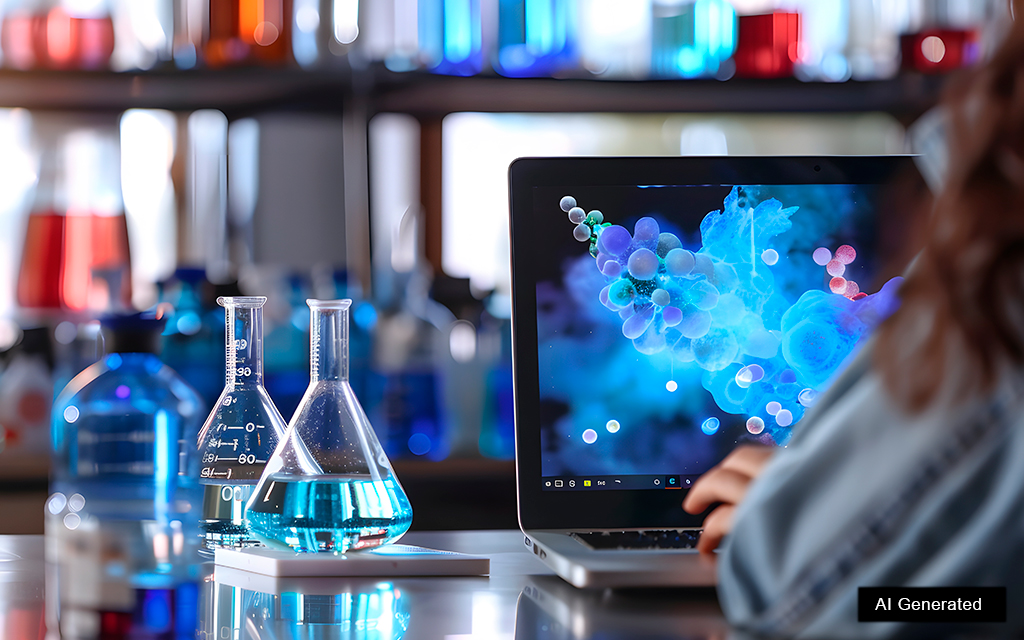
What if scientists could anticipate how harmful contaminants form and behave before they appear in drinking water systems? Thanks to advances in computational science, researchers are able to do just that.
Within the NIAGARA project, the Faculty of Polymer Technology (FTPO) in Slovenia, is using computer simulations to investigate the mechanisms behind the formation and degradation of harmful substances in water. Their work helps researchers understand these processes at the molecular level and supports the development of more efficient treatment technologies.
“Computational methods are mathematical techniques used to model, simulate and predict the behaviour of real systems,” explains Matic Pavlin from FTPO. “In NIAGARA, we use molecular docking, molecular dynamics simulations and density functional theory to study how selected pollutants degrade in water.”
These methods focus particularly on disinfection by-products (DBPs), which are generated unintentionally during water disinfection processes. According to Kaja Kupnik (FTPO), understanding and controlling these compounds is becoming increasingly important. “One of the main concerns NIAGARA addresses is a group of chemicals called DBPs,” she says. “Some are known to be harmful to human health, even at low concentrations, which makes understanding and controlling their formation extremely important.”
One well-known group of DBPs are trihalomethanes (THMs). These substances can form when chlorine, which is widely used to disinfect drinking water, reacts with naturally occurring organic matter present in the water. Although chlorination is essential for preventing waterborne diseases, some THMs have been associated with potential health risks after long-term exposure (Kumari & Gupta, 2022). As a result, THMs are among the disinfection by-products regulated in drinking water legislation in many countries, including the European Union (European Parliament & Council of the European Union, 2020).
By simulating chemical reactions on a computer, researchers can predict which degradation pathways are most likely to occur and identify the compounds that are likely to form. “The best indicator for evaluating our prediction mechanisms is comparison with experimental work,” explains Pavlin. “If the models predict a certain by-product and laboratory experiments detect it, that is strong validation.”
While theoretical predictions are not intended to replace experiments, they provide a powerful tool for guiding them. “The predictions from theoretical work are not to be blindly trusted, yet they can serve as a solid guideline for experimentalists,” says Pavlin.
This combination of theory and experimentation is one of the aspects that Pavlin finds most rewarding about participating in large European collaborations. “I am always excited when a bigger international project combines theoretical and experimental work,” he says. “It is rewarding to see that our models and predictions help experimentalists achieve their goals faster and with less effort.”
For Kupnik, NIAGARA's multidisciplinary nature is what makes the project unique. “Collaborating with such a diverse consortium broadens our network, sparks new research ideas and ultimately strengthens both the quality of our work and our capacity for future collaboration,” she says. By improving our ability to predict contaminants and understand how they behave, projects like NIAGARA are helping pave the way for smarter and more resilient drinking water systems.
References
European Parliament, & Council of the European Union. (2020). Directive (EU) 2020/2184 of the European Parliament and of the Council of 16 December 2020 on the quality of water intended for human consumption (recast). Official Journal of the European Union, L 435, 1–62. https://eur-lex.europa.eu/eli/dir/2020/2184/oj
Kumari, M., & Gupta, S. K. (2022). Cumulative human health risk analysis of trihalomethanes exposure in drinking water systems. Journal of Environmental Management, 321, 115949. https://doi.org/10.1016/j.jenvman.2022.115949